Logics
Logics of Improvisation
The attempt is to find and define principles that are an integral part of an improvisation. We call these principles logics.
Logics are present in every improvisation and are consciously or unconsciously adjusted and modified by the dancer. Individual parameters of these logics can be defined in advance and thus emphasize the tone or a specific style of an improvisation.
Working with scores, for example, has a similar effect; however, a score defines the parameters of these logics indirectly, for instance through floor patterns, temporal grids, or text instructions. The term logics and the use of this principle aim at a direct and highly conscious influence on as many conditions as possible or wanted that constitute and generate an improvisation.
We propose dividing the framing of an improvisation into three areas:
Unset Logics refers to logics whose parameters can be freely shaped by the dancers within an improvisation.
Set Logics refers to logics whose parameters are defined at the beginning of an improvisation.
Set of Rules refers to a minimal set of rules that must be strictly followed.
treemap-beta
"New Improvisation"
    "Logics"
        "Unset Logics":70
        "Set Logics":15
    "Set of Rules"
        "Set Rules":15
Example configuration for an improvisation — block sizes adapt based on the amount of defined parameters.
The following list of logics is currently unsorted but is intended to receive a meaningful structure in the near future. The number of logics is likely far greater than can be fully captured in writing. Therefore, we propose the following logics more as inspiration—for further thinking, transformation, and reinvention—rather than as a complete list.
Some logics function more as auxiliary mechanisms than as complete descriptions of conscious or unconscious processes within an improvisation. These mechanisms are intended to make complex processes more tangible and to align the internal experience of improvisation (the dancer’s experience) with the external experience (that of the audience). The goal is therefore to strengthen the performative quality of an improvisation.
Firewall
The firewall is a conceptual mechanism for controlling the input and output of a dancer.
Input refers to all external influences and how strongly they are responded to or incorporated into the creative process. These may include sound, other dancers, light, and all other environmental influences.
Output refers to everything that reaches the audience from the improvising person. That is, the degree of directness of all intended or unintended movements. A guiding question might be: As a spectator, do I see what the dancer intends? Or what percentage of it do I see?
Both parameters can, for example, be expressed as percentages and thus define a target state for the dancer. They can be set at the beginning of an improvisation or consciously or unconsciously modified during it.
NOTE: Can be an internatl input and an external input
Example:
Firewall
    Input {50%}
    Output {90%}
Composed (CMP) + Uncomposed (UNCMP)
Composed and Uncomposed are two collections of elements that make a dance improvisation appear composed or uncomposed. Both share the same goal: making a conscious choice about the effect of an improvisation.
NOTE: Very context related
CMP
    > clear positions (in space)
    > long, readable moments / gestures
    > clear directions / lines / diagonals
    > exits and entrances
    > clear looks towards persons, objects and movements
    > reactions that mean something
    > developing proximity
    > starts and stops
    > thoughtful material
    > drops and restarts of movement sequences
    > movements the spectator can relate to
    > commenting
    > initiating the end
    > not moving
UNCMP
    > random, scattered timing
    > rigid time grid (fixed or given, steady rhythm)
    > changes (theme, topic, persons, space…)
    > unjudged (uncommented) consequences
    > getting lost (or focused) in movements and gaining clarity through that
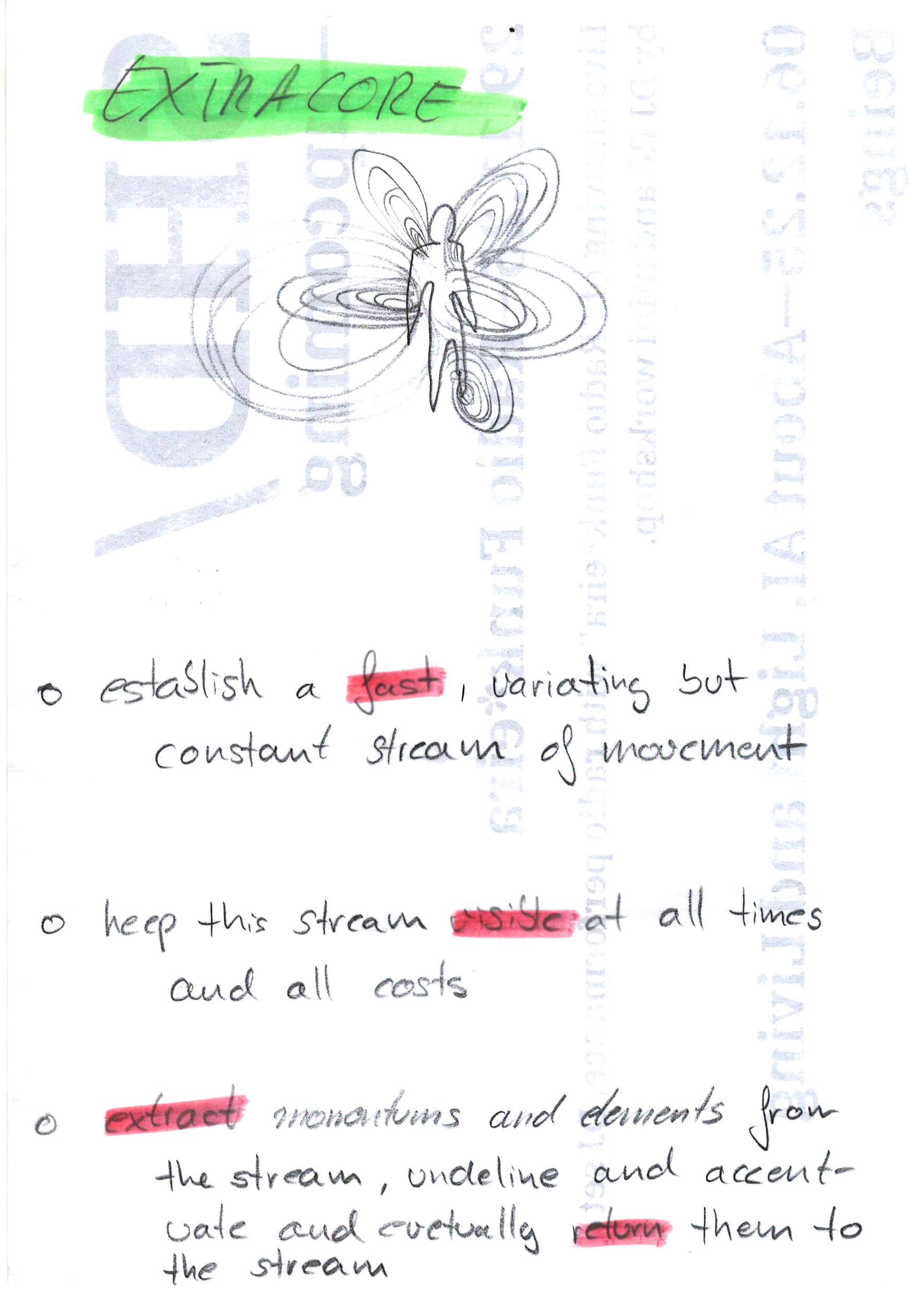
Source Core / Whitebase
This logic can be a developed (movement) base on which an improvisation is performed. This base can be represented using a score or developed and documented through other methods. A whitebase functions like white noise and continuously underlies an entire improvisation or a section of it. Its purpose is to create a certain consistency across multiple improvisations or among different performers.
A so-called steɪt (see section “steɪts”) can also be used as a whitebase. It is very close to a conventional score but describes, among other things, a temporally unlimited state.
NOTE: Aktion and a state / What and how
Big gap
BigGap
    Inside {A}
    Outside {B}

OR

BigGap
    Inside {A}
    Outside {A}
Internal perception (dancers) is not necessarily the same as external perception (audience). It is the big gap between the performer and the audience.
It can result for example in (movement) material that feels uncomfortable internally but generating tension and interest externally. Conversely, material that feels good internally may appear completely boring externally.
Therefore, the subjective feeling of a particular material should be handled consciously, and an external perspective should be adopted as much as possible.
For this purpose, the parameters Inside and Outside can be set and may be equal or unequal depending on the moment.
Transmitter
Transmitter refers to the idea that an improvising person always reacts to different inputs, transforms them in some way, and passes them on.
For example, when there is an existing or suddenly emerging sound—from outside, within the stage space, or from the environment—it is decided how this sound influences the improvisation. The dancer thus functions as a kind of transmitter between the audience and the environment. The degree of transformation of different impulses can be consciously chosen.
Transmitter
    IN {all} = OUT {all}

Transmitter
    IN {movement} = OUT {voice}

or

Transmitter
    IN {exhaustion} = OUT {slow movement}
Intensity
There are multiple types of intensity: one can be created, for example, through fast and large movements. In contrast, very slow movement can also create intensity.
The relationship between intensity and movement quality should always be questioned and continuously reassessed during improvisation.
NOTE: Extend the scale. Context, Dramaturgy, Closenss, Space
Intensity
    check = what creates intensity, and for who

Inntensity
> context
> drmaturgy
> proximity
> duration
> ...
Deep Impro (DIMP)
Deep Impro is a logic and can simultaneously be used as a complete improvisational principle.
DIMP means that everything is completely improvised. However, the attempt is to prevent all unconscious processes that manipulate or control other logics. In other words, neither conscious nor unconscious controlling or shaping interventions should take place.
This principle is probably impossible to fully realize. The serious and continuous attempt to do so is sufficient as a principle.
DIMP
    Logics (unconscious, conscious) = 0
Movement as Source (MAS)
MAS is a principle similar to Deep Impro (DIMP). Movement itself is the only permitted source for generating movement, making improvisational decisions, and influencing all other elements governed by logics.
It remains completely open what generates the movement—as long as the current movement is genuinely the source.
If a movement produces, for example, an emotional quality, a voice, or another specific reaction, this falls within the MAS principle.
MAS
    Logics (source) = {movement}
Loops
XXX
∧¬ Friction, Not Research (NOR)
We were deeply occupied with the question of when improvised material begins to take on the appearance and character of research. As described in the section Improvisation, our aim is not to present research. Instead, we are attempting to generate a kind of movement white noise — movement that is not meaningful, narrative, or structured according to a fixed dramaturgy. Ideally, this is also how it is perceived by the audience, and we continuously asked ourselves how such a state could be achieved.
One crucial aspect is the duration for which an emerging element is sustained. If this duration is too short, the improvisation starts to appear as a process of searching. However, our approach is not concerned with searching, but with allowing things to remain and unfold.
During rehearsals, we arrived at the image of frictionlessness. In mechanics, an object that receives an impulse will continue moving with the same momentum unless another force interrupts or alters it. On Earth, friction constantly interferes with this fundamental principle. We adopted the idea of a frictionless system as a core principle of our improvisational approach: once a movement is initiated, the movement itself — together with its consequences and effects — remains present throughout the entire improvisational setting. There are no stops, no frictions, no deletion of movement. Improvisation therefore becomes a continuous mechanical accumulation of movement and its effects: cause and effect.
From this, we established the parameter Friction, which can be set between 0 and 1. For our approach, we prefer values close to 0.
Friction {0.1}
Ignoring
XXX
Loops
XXX
To doubt and being convinced (DABCON)
XXX
Understanding is boring, not understanding is boring (UBNUB)
Camouflaing, complexifing as strategies against it. Not fix meanings, but let them be.
Floorlevel
sec.
Spacelevel
%
Fluchtgeschwindigkeit / Escape Velocity
Level of output that is needed for a certain situation or space to leave it's contextual reality and step in another dimenson.
Magic Spices / Drugs
Changing
Voice
How to use...?
Poetry
How does it happen and when?
Stops / Boycott / Fuck it
Don't hide what you need. Interrupt things, if wanted. Stop if needed. Restart if things goes wrong.
The Start / The End
Start -->
Start
> take time at start, closed eyes, not moving
> different start depending on situation
> direkt starting
> spacial: far away, in the middle, on the side
> sneaking in (movement or spacial)
> start with open firewall
> start with specific movement
> start with movement
> start with a pose
> choosing the space or amount of audience concentration you want
>


End
> time cut
> transfer the "core" to someone else
Steɪts
Scans of different steɪts.